
READING A SITE OF CONSCIENCE
Place, Testimony and Memory
at SETU College Street
A self-guided Waterford Memories Project tour
WELCOME
You are standing within a complex of buildings that formerly incorporated:
-
St Mary’s Good Shepherd Magdalene Laundry
-
St Dominick’s Industrial School
-
Good Shepherd Convent and Chapel
The College Street site was occupied by the Good Shepherd Sisters from 1884. St Mary’s Magdalene Laundry operated here until 1982. The site subsequently became part of what is now South East Technological University.
This brief self-guided walk uses place, survivor testimony and the surviving architecture to explore aspects of this history.
You will visit four locations:
1. THE CHAPEL
Religion, separation and institutional routine
2. ST DOMINICK’S WINDOW
Looking beyond the institution
3. NUNS' PARLOUR
Separate spaces within one complex
4. THE MAGDALENE LAUNDRY
Labour, confinement and institutional transformation
HOW TO USE THIS TOUR
At every stop:
👁 LOOK
Spend a moment examining the physical space before playing anything.
🎧 LISTEN
Play the short oral-history extract.
Headphones are recommended.
If using a phone speaker, please keep the volume low.
💭 REFLECT
Consider the question provided before continuing. There is no required answer.
ACCESS AND VIRTUAL EXPLORATION
If you cannot or do not wish to complete any part of the physical route, you can explore the College Street buildings virtually.
You can also explore the historical layout of the former institutional complex:
CONTENT NOTE
The oral histories include first-person accounts of institutionalisation, physical abuse, hunger, confinement, restricted movement and unpaid laundry labour.
Please engage with the recordings at your own pace.
Your route
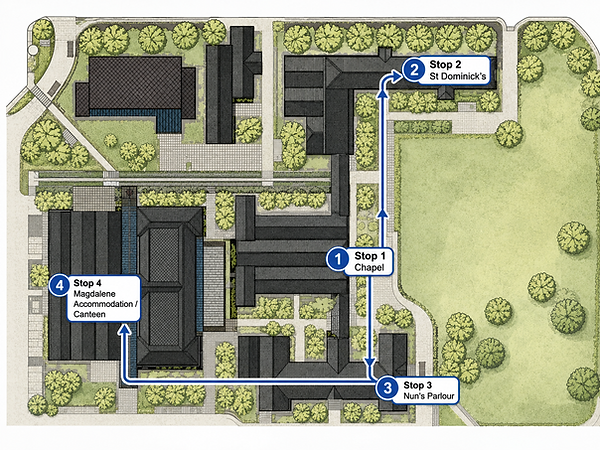
STOP ① THE CHAPEL
START YOUR WALK HERE
The Chapel formed part of the interconnected Good Shepherd complex at College Street and was shared by those living in St Mary’s Magdalene Laundry, St Dominick’s Industrial School and the Convent. Its architecture nevertheless maintained separation between these communities.
Three distinct sections can still be identified within the Chapel. Separate corridors connected these areas to different parts of the complex: one led from the Laundry to the seating used by Magdalene women; another provided access for the nuns and other members of the community; and a separate route connected the Chapel to St Dominick’s Industrial School (O’Mahoney & McCarthy, 2026, pp. 14–15).
The corridor from the Laundry included what was known as the “penitent’s entrance”, leading directly into the left side of the Chapel where the Magdalene women sat for Mass (O’Mahoney, Bowman Grieve, & Torn, 2019, pp. 199–200).
Survivor Kathleen R., who experienced both St Dominick’s and Magdalene Laundries including Waterford, remembered the nuns seated in the middle, the Industrial School children on one side and the Magdalene women on the other.
👁 LOOK
Take a moment to look around the Chapel.
Notice:
-
the different sections of seating;
-
the entrances and exits;
-
the aisles and internal divisions;
-
the doors and corridors connecting the Chapel to the surrounding buildings.
-
Consider how people could occupy the same religious space while remaining physically separated from one another.
🎧 LISTEN
Martha: The Chapel and everyday life in St Dominick’s
Martha entered St Dominick’s Industrial School as a young child and remained there until she was sixteen. In this extract, she recalls going to the Chapel, repeated prayer and confession, and then speaks about work and education within St Dominick’s. Her account places religious observance within the wider routine of institutional life.
💭 REFLECT
How did religious practice operate alongside separation, work and institutional routine?
Take a moment to look again at the different sections and entrances before leaving the Chapel.
NEXT → STOP ②
NEXT → ② ST DOMINICK’S WINDOW
ST DOMINICK'S INDUSTRIAL SCHOOL: Looking beyond the institution
Leave the Chapel and follow Route ② on your map towards the former St Dominick’s Industrial School.
YOUR DESTINATION
The second floor of the former Industrial School building. When you reach the stairs proceed to the 2nd floor window.
YOU SHOULD NOW BE AT THE SECOND-FLOOR WINDOW MARKED ②.
This stop asks you to think about the difference between seeing beyond an institution and being free to leave it.
Survivors describe high walls, restricted thresholds and controlled circulation as material features of confinement and institutional surveillance (O’Mahoney et al., 2019, pp. 196–205; O’Mahoney & McCarthy, 2026). A survivor of St Dominick's Industrial School told us about how she could only see out of the institution and over the wall twice a day from this window - first thing in the morning and last thing at night.
Stand at the window.
Look outward towards Waterford City.
-
What can you see from this height?
-
What can you see that would be obscured from ground level behind a high wall?
-
What movement is taking place outside the building?
-
How would this view differ if you were a child?
🎧 LISTEN
Martha remembers looking outside
💭 REFLECT
What is the difference between being able to see the city and being free to move through it?
Take a moment at the window after the recording finishes.
NEXT → STOP ③ THE NUNS’ PARLOUR
You are now beginning the return journey back towards the Canteen.
Return back down along the long hallway (pass the Chapel on your right)
Continue to the end of the hallway.
TURN LEFT.
Enter the Nuns’ Parlour — Room C014.
This room formed part of the former Good Shepherd Convent. This stop introduces another part of the spatial organisation of College Street: the distinction between the Convent occupied by the religious community and the areas occupied by girls and women.
Research on the Waterford buildings describes the Convent interior as containing patterned tiles and handcrafted woodwork. Girls and women confined elsewhere in the complex were not normally permitted into this part of the site except on arrival/departure or to undertake cleaning. Although the Convent and Laundry were physically linked by a corridor, access for the women was controlled by the many locked doors in the hallways outside this room (O’Mahoney, Bowman Grieve, & Torn, 2019, pp. 196–199).
Consider that this was a domestic space belonging to the religious community, distinct from the residential and working areas occupied by the girls and women. Look closely at the room and its relationship to the corridor you have just travelled.
👁 LOOK
Notice:
-
its location within the former Convent;
-
architectural and decorative details;
-
windows and doors;
-
the relationship between this domestic room and the institutional spaces you have just visited.
🎧 LISTEN
Angelina: Cleaning the convent
Angelina (pseudonym) was born in Waterford in 1959 and was raised in St Dominick’s Industrial School for Girls within the Good Shepherd complex at College Street. Angelina was admitted as an infant and therefore did not remember arriving at St Dominick’s. The testimony below, therefore, begins not with her arrival but with one of her earliest memories of life inside the institution, where Angelina recalls being required to work from early childhood polishing long corridors and cleaning the church, convent and "offices".
The following extract is read from Angelina's oral-history testimony provided to Justice for Magdalenes Research (JFMR) by voice actors (Dr Kate McCarthy of the Waterford Memories Project and Nick McCarthy).
John: Working within the Good Shepherd complex
John trained as a plumber with John Hearns Builders and Contractors, a company responsible for maintenance and construction work within the Good Shepherd complex. As an apprentice, he worked throughout the convent; he later returned as a subcontractor through his own company. In this extract, John recalls the parlour as a space in which professional visitors to the convent were received. He remembers accompanying a mechanical engineer to site meetings and being brought into the parlour for lunch.
💭 REFLECT
What does it mean to be excluded from a domestic space while being required to maintain it?
Take a moment to look again at the room before continuing towards the former Magdalene Laundry and your last stop on this tour.
NEXT → STOP ④ MAGDALENE LAUNDRY
→ GO TO STOP ④
Leave the room, turn right, and follow this hallway through the buildings to reach the Canteen.
THIS IS THE FINAL STOP ON THE TOUR.
St Mary’s Good Shepherd Magdalene Laundry formed part of the interconnected College Street complex. The physical Laundry operated here until 1982. In this part of the building, Laundry work took place on the ground floor, while sleeping accommodation for girls and women was located on the second and third floors above. Although the Laundry and Convent were physically connected by a hallway, movement between them was restricted by locked doors (O’Mahoney, Bowman Grieve, & Torn, 2019, pp. 196–200).
👁 LOOK
Before listening, take a moment to examine the space around you.
Notice:
-
walls, windows and thresholds;
-
the relationship between the ground floor and the floors above;
-
corridors connecting different parts of the complex;
-
older architectural features alongside adaptations for the building’s present use.
Think about the proximity of work, accommodation and restricted movement within the same building.
🎧 LISTEN
Elizabeth: From Industrial School to Magdalene Laundry
Elizabeth describes herself in her oral history as an “ex-industrial school” and “ex-Magdalene Laundry woman”. She later spent time in the Waterford Magdalene Laundry and remained there until shortly before her nineteenth birthday.
In this extract, Elizabeth moves beyond the details of one institution to reflect on what she understood as the relationship between industrial schools and Magdalene Laundries. She discusses the roles of the State, the courts, education authorities and the Church and describes what she saw as a pattern through which girls from industrial schools entered Magdalene Laundries.
💭 REFLECT
How does standing within the former Laundry change the way we understand Elizabeth’s account of movement between institutions, work and confinement?
WALK COMPLETE
YOU HAVE FINISHED THE SELF-GUIDED ROUTE
The physical walk ends here at the Canteen.
You can now continue to IHA registration.
Thank you!
ABOUT THE TESTIMONIES USED ON THIS WALK
The testimonies presented on this page describe different people, institutions, periods and experiences. They should not be understood as a singular account of life within the College Street complex.
Continue exploring in your own time
INTERACTIVE HISTORICAL MAP
Explore the historical relationship between the Magdalene Laundry, Industrial School, Convent and Chapel.
The Waterford Memories Project uses digital and place-based educational resources to locate survivor narratives within the physical history of the College Street complex
https://www.waterfordmemories.com/interactivemap
EXPLORING WATERFORD’S MAGDALENE HERITAGE
The Waterford Memories Project developed Exploring Waterford’s Magdalene Heritage as a research-informed multimedia educational resource using the Waterford site as a case study
https://www.waterfordmemories.com/activity-and-resource-pack
ORAL HISTORIES
Explore further testimonies and learn more about those who contributed their experiences to the Waterford Memories Project.
https://www.waterfordmemories.com/oralhistories